
Duration
Required experience
Minimum age
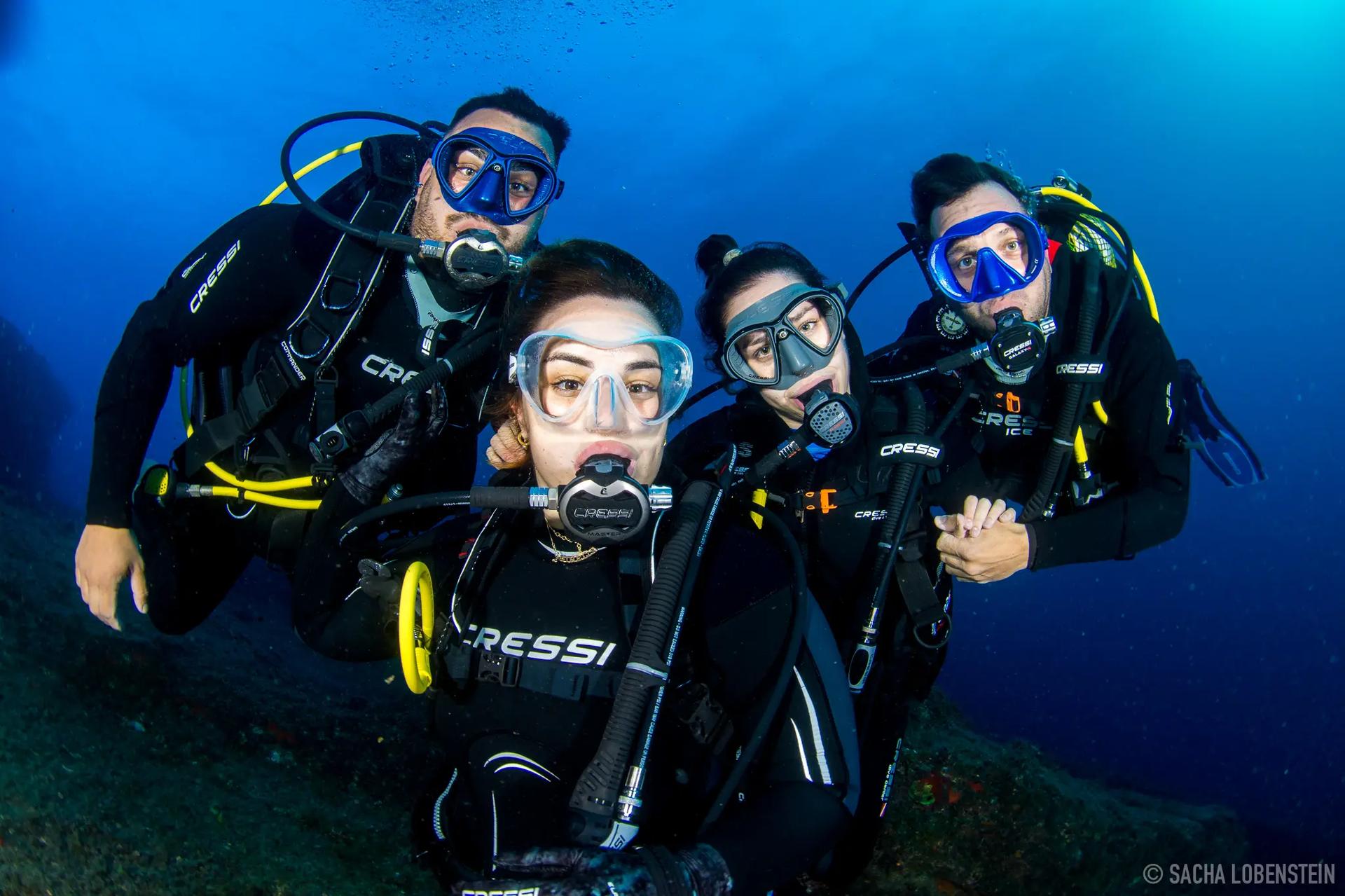
🌊 Discover the Underwater Paradise of El Hierro 🌊
🐠 A Variety of Dives for All Skill Levels
In El Hierro, a range of diving experiences awaits, from calm, shallow waters for beginners to challenging currents for advanced divers. Dive into tranquil waters or test your skills against the currents, depending on your preference and skill level.
🏝 Premier Diving Spots in Spain
El Bajón and La Restinga: Underwater Jewels
El Bajón: With breathtaking underwater landscapes.
La Restinga de El Hierro: Explore the biodiversity at one of the country's top diving sites.
These destinations will amaze you with their rich ecosystems and invaluable ecological value, where marine life thrives in harmony.
🌡 Ideal Underwater Climate
A Home for Diverse Species
The water temperature, ranging from 18 to 25º C year-round, invites both tropical and Mediterranean species to coexist in these crystal-clear waters. The lush underwater vegetation and rocky seabeds serve as a refuge for a wide variety of marine flora and fauna.
🛥 Daily Diving Excursions
Limitless Exploration
Frequency: Two standard morning departures, with the possibility of up to four daily dives, including a night dive, tailored to your needs.
Accessibility: Most dive sites are just minutes away from the La Restinga pier.
🌞 El Mar de Las Calmas: Enviable Weather
Exclusive and Protected Diving
Thanks to its sheltered location, El Mar de Las Calmas offers nearly perfect conditions every day of the year. The reserve limits anchoring to one boat per buoy, ensuring an intimate and uncrowded diving experience.
🌐 Beyond the Conventional
Adventures on the East Coast and Beyond
Diversity of Sites: We also explore the East coast and special points like La Caleta, Roques de Salmor, among others.
Unique Experiences: Occasional opportunities to visit less-known but equally spectacular locations.
Dive into El Hierro and discover for yourself why this island is a true paradise for diving enthusiasts. With clear waters, abundant marine life, and a variety of dive sites, each dive promises to be an unforgettable adventure. 🐟🌴
El Desierto
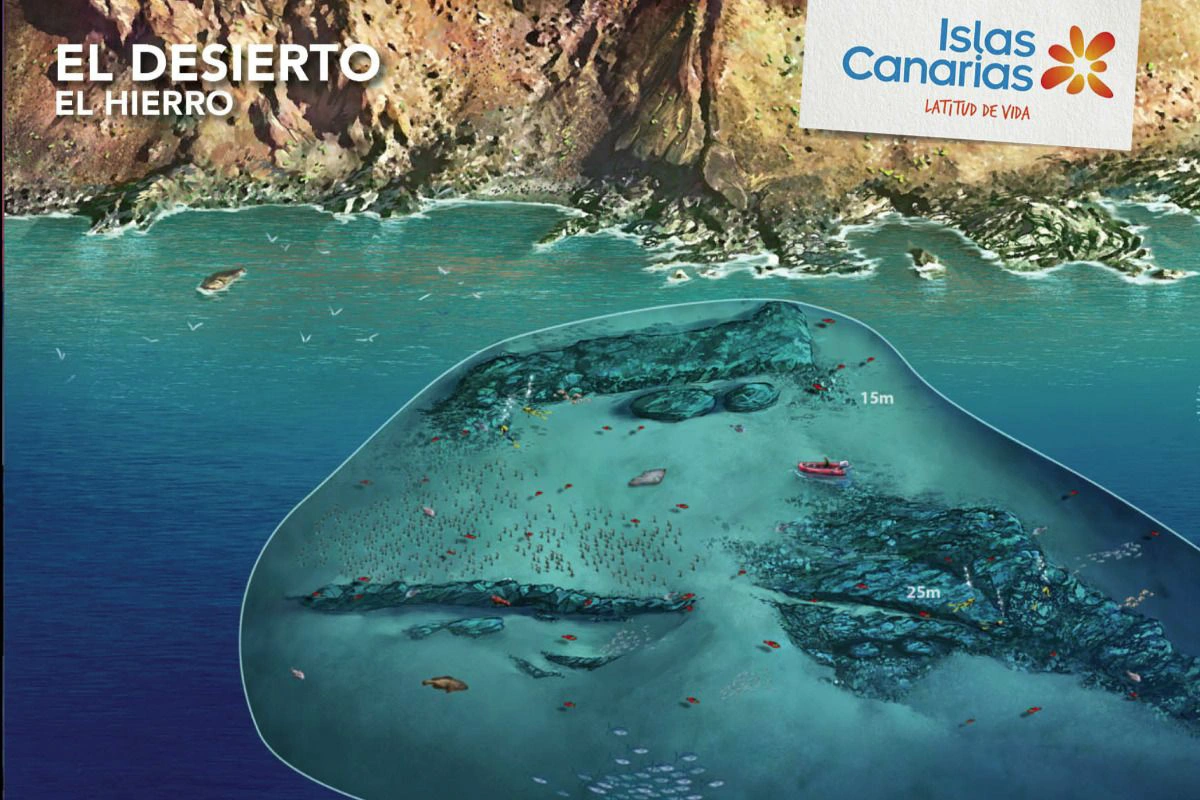
Located on the western edge of the Marine Reserve, this area begins near the shore with a rocky bottom covered with algae that abruptly drops forming a rather tortuous veril at a depth of just over 10m. This serial has numerous crevices, arches and small caves that serve as shelter for numerous moray eels and murres, as well as shrimps and crabs. A good place to entertain yourself looking for hidden fauna, although it may be advisable to leave it for the end of the dive if we intend to descend to the deepest area, which is located in a southerly direction after leaving behind a slightly sloping area surrounded by patches of black sand. Here the bottom drops again forming another slope more or less parallel to the coast, ranging from almost 30m deep to more than 40m. There are also cracks and caves, although on this occasion the stars are the abbots, jacks or even a place of passage for the famous devil rays. If we move leaving the wall to our right, this loses height and the bottom becomes sandy, abounding garden eels and being a good place to see kept or stingrays.
Level: Advanced
Currents: Yes, low - medium intensity
Depth: 30 m
Difficulty: Low
Sea / Ocean Departure from boat
Water Temperature: 19º in winter - 23º degrees in summer
Outside temperature: 20º in winter - 26º in summer
Visibility: High (30m)
Sea bottom: Sand and stone
MARINE SPECIES
Garden eels, Groupers, Manta rays, Moray eels, Devil rays, Tuna fish
Baja Rosario
This small shoal rises to a depth of 7 m from a rocky bottom furrowed by small tongues of lava, with some patches of sand and on which there are numerous blocks of stone. This structure forms a multitude of nooks and crannies disguised by the abundance of algae, feels a good place to observe a very varied shallow fauna: old, abbots, Sargos, moray eels, blue roosters, spiny drumlins, etc.. It is also common to see small groups of amberjacks. In this dive we do not usually go beyond -25m, although if we descend further we can reach a steep area with black coral branches. In this dive is where the famous Sun - Ray shark that visits our coasts in the summer seasons is located.
Level: Advanced
Currents: Yes, low to medium intensity
Depth: 30 m
Difficulty: Low
Sea / Ocean Departure from boat
Water Temperature: 19º in winter - 23º degrees in summer
Outside temperature: 20º in winter - 26º in summer
Visibility: High (30m)
Sea bottom: Sand and stone
MARINE SPECIES
Amberjacks, groupers, manta rays, sharks, devil rays, blue grouper, blue megrims
El Salto
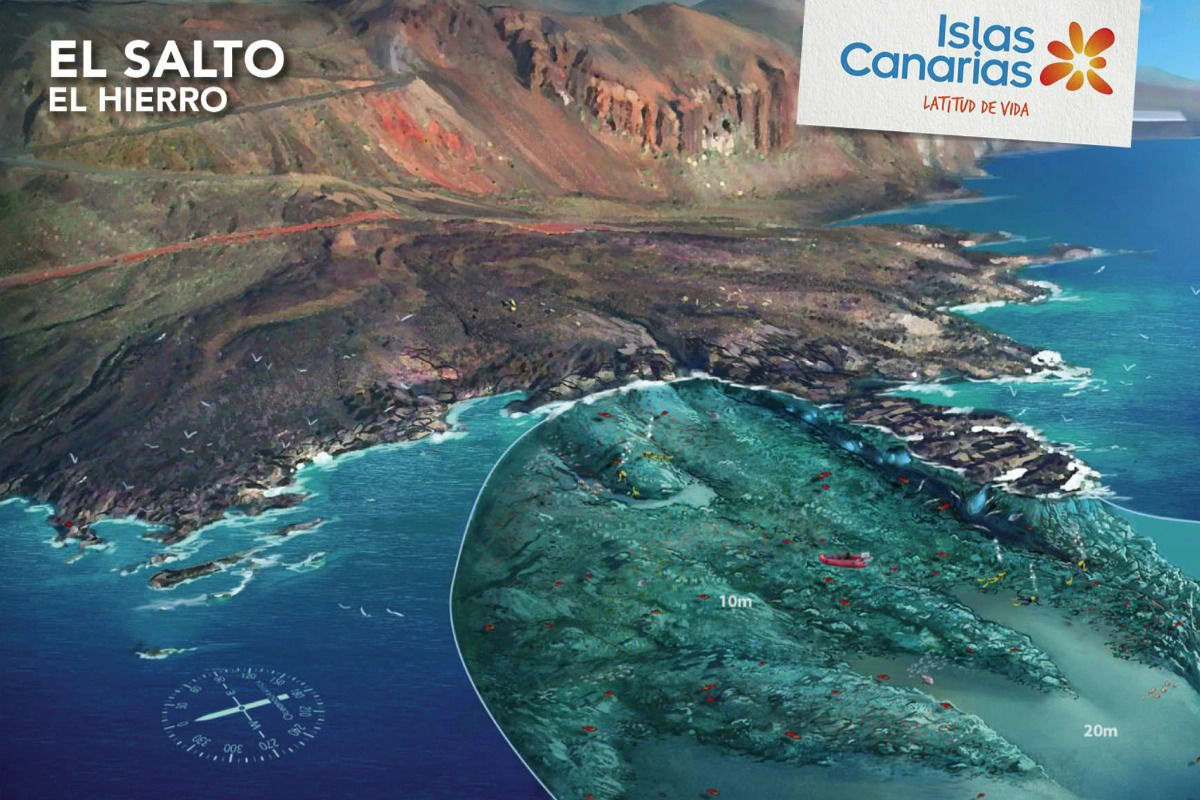
The lava tongue that forms the tip of the fall continues under the sea and descends progressively until it blends into the surrounding rocky bottom. In its shallower area, the rocky lagoon is perforated by small diveable caves and a tunnel with light entrances in the ceiling that form beautiful play of light in the interior. These shallow caves are inhabited by herreña lobsters, canary cicadas and shrimps, and it is not uncommon to see a group of salema when entering the main tunnel. Parallel to the rock wall descends an August ravine that passes between two promontories of rock and is usually the favorite place of trumpet fish, being able to see sometimes groups of more than 20 specimens. It is a dive that does not exceed 20m depth, since the most varied and interesting is in the shallow area around the tip. It is an easy and fun dive, but it loses its appeal if it is affected by the sea bottom and we can not go through the tunnel and caves.
Level: Advanced
There are currents: No
Depth: 20 m
Difficulty level: Low
Cave / Cenote Departure from boat
Water Temperature: 19º in winter - 23º degrees in summer
Outside temperature: 20º in winter - 26º in summer
Visibility: High (30m)
Sea bottom: Rocks
MARINE SPECIES
Trumpet fish, Abade, Manta rays, Lobster, Blue Grouper, Blue Marlin
El Rincón
This dive starts right where the jetty breakwater joins the Punta Restinga reef. It is usually the most sheltered and calm of all the dives we do in this reef, especially in case of current. We go down with the breakwater reefs in sight and continue towards the beginning of the cliff of Punta Restinga. Following the wall of this and at different heights, there are numerous cracks and small caves that serve as home to moray eels and murres. The fauna is abundant and varied, with many old women, blue roosters, poplars, jacks, etc.. The logical thing to do is to go along the wall of the reef at its base and then make the reverse path but at a shallower depth. It is precisely the shallowest part of the reef that I find most attractive, with parallel gullies and a greater abundance of fish, which tend to be trusting of the diver.
Level: Open Water
There are currents: No
Depth: 18 m
Difficulty: Low
Sea/Ocean
Departure from boat
Water Temperature: 19º in winter - 23º degrees in summer
Outside temperature: 20º in winter - 26º in summer
Visibility: High
Sea bottom: Sand and Rock
MARINE SPECIES
Mantas, Cuttlefish, Octopus, Turtles, Manta Rays, Stingrays
Cueva del Diablo
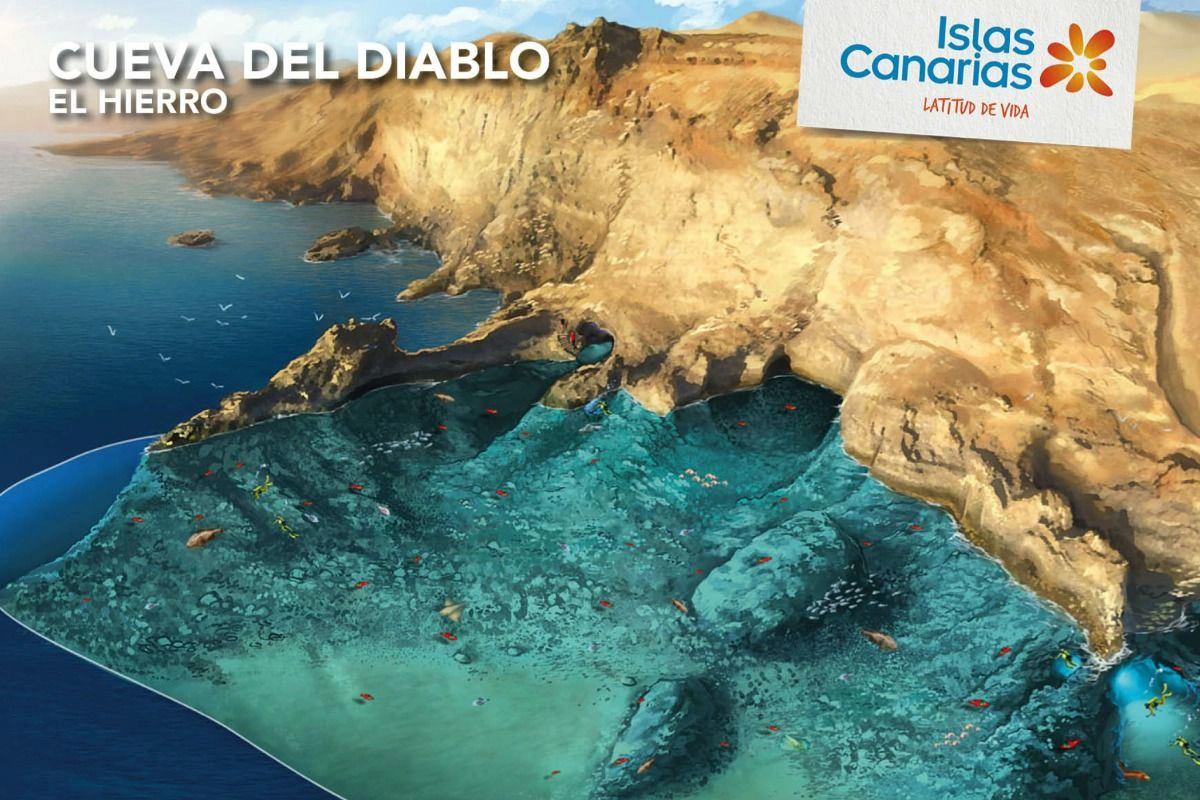
This dive takes place next to the rocky cliff, where the "Devil's Cave" is located, a well-known land cave that can be entered by swimming or even with a small boat if the tide is right. Nearby there is a fairly wide cavern that opens on a sandy bottom about 8m deep. The cavern is open at the top in two large skylights, so light enters the entire central area, especially after midday. It is possible to find the two types of lobster in its most recondite areas, as well as the spiny drum, in addition to the small fauna of crustaceans typical of caves. On the outside of the cave the bottom is sandy with some loose rocks and we will not exceed 15m in the entire dive. There is also a stone arch in front of the devil's cave, only 5m deep, which we can visit before ending the dive, a very simple dive and suitable for all levels of diving despite being a cave.
Level: Open Water
There are currents: No
Depth: 17 m
Difficulty level: Low
Cave/ Cenote Departure from boat
Water Temperature: 19º in winter - 23º degrees in summer
Outside temperature: 20º in winter - 26º in summer
Visibility: High (30m)
Sea bottom: Sand and rock
MARINE SPECIES
Octopus, Groupers, Manta rays, Moray eels, Spiny dogfish, Lobsters, Tunas
Punta Lajial
In this area the rocky bottom has a steep slope quite homogeneous ranging from about -10m to more than -40m. From a certain depth, the bottom is covered by lava dykes perpendicular to the coast that break the monotony of the slope. In these reliefs most of the fauna is usually concentrated: abbots, bream, roosters, dogfish and groupers, some of them of good size in the deepest part, although we should not expect them to be as confident as in other areas.
The slope becomes steeper from 35-40m, where black coral begins to appear on the rock ledges. At this bottom depth is easily gained, due to the slope and the usual clarity of the water, so we must be careful not to exceed our safety limits. Anyway, it is in the reliefs and crevices of the stone dykes where we have the most interesting part of the dive.
Level: Open Water
There are currents: No
Depth: 40 m
Difficulty: Low
Sea/Ocean Departure from boat
Water Temperature: 19º in winter - 23º degrees in summer
Outside Temperature: 20º in Winter - 26º in Summer
Visibility: High (30m)
Sea bottom: Sand and Rock
MARINE SPECIES
Groupers, Abade, Manta rays, Lobsters, Blue Grouper, Blue Roosters
Punta Restinga
The area of Punta Restinga is just in front of the fishing pier of the town of La Restinga, at the southern tip of the island of El Hierro. It is a submarine lava tongue with a very varied relief: cliffs, veriles, sandy platforms, caves. On these seabeds, the diver can encounter large groupers, spot imposing stingrays gliding over the sand and follow graceful trumpet fish in their search for small prey.
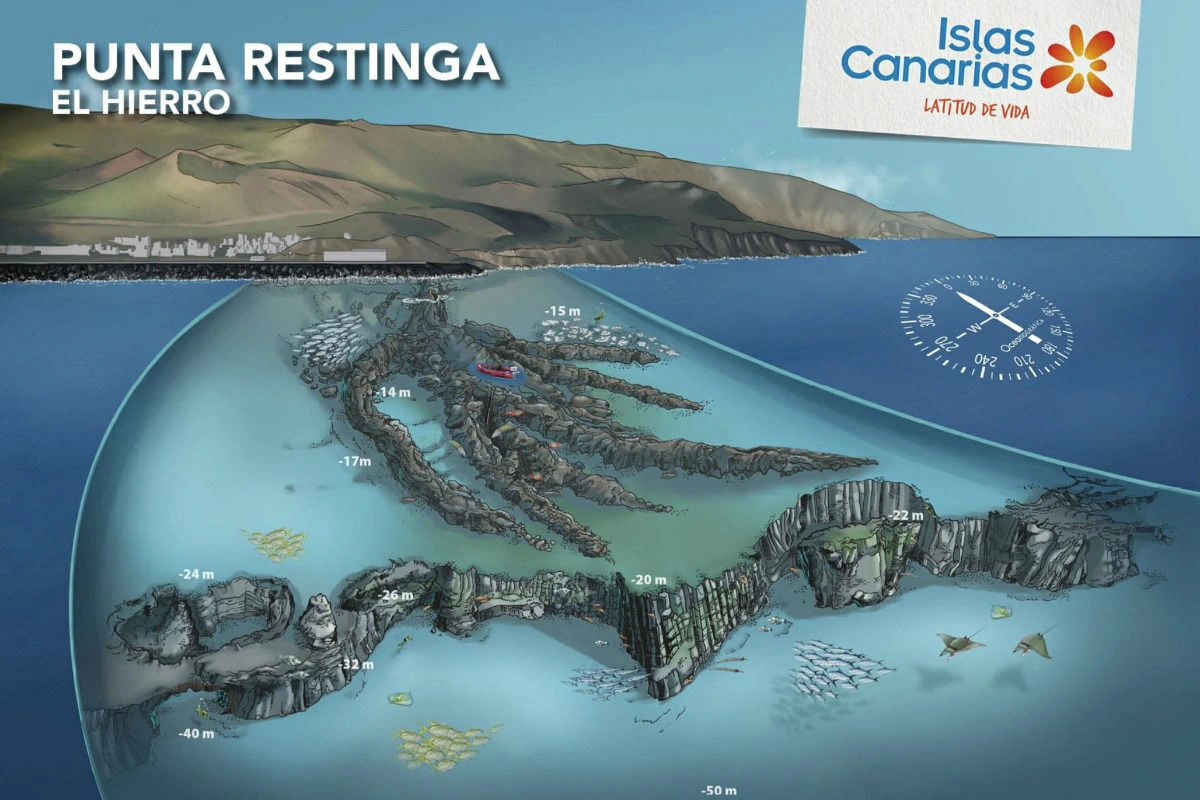
Level: Advanced
There are currents: Yes, medium - high intensity
Depth: 30 m
Difficulty: High
Sea / Ocean Departure from boat
Water Temperature: 19º in winter - 23º degrees in summer
Outside temperature: 20º in winter - 25º in summer
Visibility: High (30m)
Sea bottom: Rocky
MARINE SPECIES
Devil rays, Groupers, Manta rays, Moray eels, Spiny dogfish, Lobsters.
El Bajón
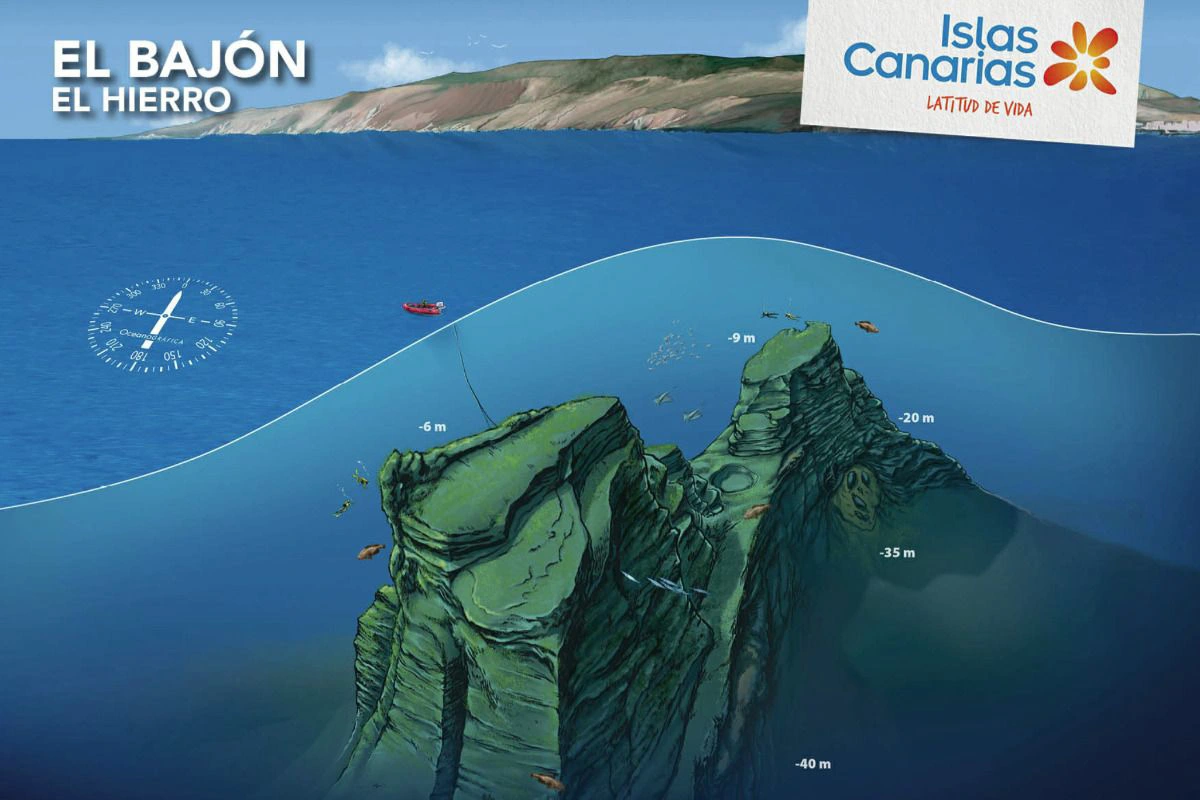
A sharp underwater mountain of vertical walls where currents feed a varied and abundant marine fauna. Located at the southern tip of the island of El Hierro, in front of the fishing village of La Restinga, this low two mounds of nine meters deep, is one of the best dive sites of the Marine Reserve La Restinga-Mar de las Calmas and considered one of the best diving spots in Europe.
They are inhabited by lots of murions and surprisingly large groupers. Groups of macaws, abades and a great variety of species will be waiting at the top of the cape, and if during the dive we look towards the blue, it is very likely to see large pelagic species such as amberjacks, devil rays or even get to see the great whale shark.
Level : Advanced
There are currents: Yes, medium - high intensity
Depth: 60 m
Difficulty level: High
Sea / Ocean Departure from boat
Water Temperature: 19º in winter - 23º degrees in summer
Outside temperature: 20º in winter - 25º in summer
Visibility: High (30m)
Sea bottom: Rocky
MARINE SPECIES
Devil rays, Tuna, Amberjacks, Groupers, Manta rays, Moray eels, Black sea bream, Black sea breams
Equipment rental
Are you a diving center?
If you run a dive center and are looking for a way to increase your visibility, attract new clients, and manage your reservations efficiently, Scuba Finders is your solution. Join our free platform and discover how we can help you grow. Be part of a network of trusted dive centers and take advantage of all the benefits that Scuba Finders has to offer. Don't wait any longer, start diving towards success today!
Register center